
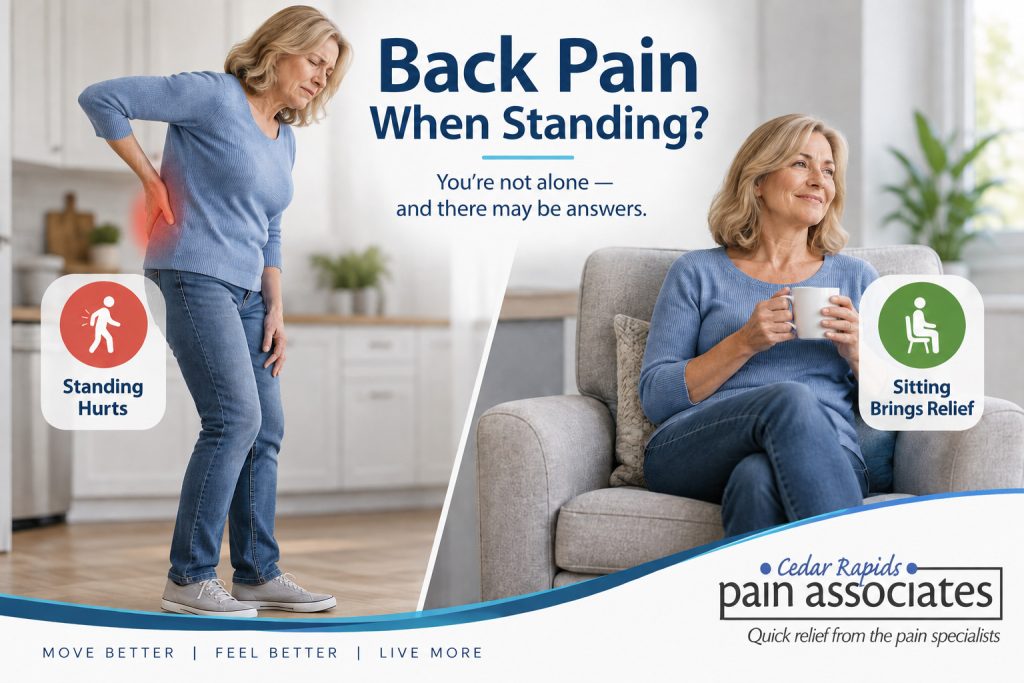
🧍 Standing hurts.
🚶 Walking makes it worse.
🪑 Sitting down brings relief.
Does this sound familiar?
Maybe you can walk through the grocery store more comfortably when leaning forward on the shopping cart. Or perhaps standing at the kitchen counter bothers your back, but sitting down provides almost immediate relief.
This pattern of pain can provide an important clue about what may be causing your symptoms.
One possible cause is lumbar spinal stenosis, although arthritis, irritated spinal joints, disc problems, and other conditions can produce similar symptoms.
🔵 What Is Lumbar Spinal Stenosis?
Lumbar spinal stenosis occurs when the spaces around the nerves in the lower spine become narrowed.
Several age-related changes can contribute to this narrowing:
🔹 Arthritis and bone spurs
🔹 Thickening of spinal ligaments
🔹 Bulging or herniated discs
🔹 Degenerative disc disease
🔹 Changes in the small facet joints of the spine
When these changes reduce the amount of room available for the nerves, standing and walking may place additional pressure on them.
🧍 Why Does Standing Make It Worse?
Your lower spine naturally moves into a slightly more extended position when you stand upright. In someone with spinal stenosis, this position can further decrease the space available for the spinal nerves.
Common symptoms may include:
🔸 Low back pain
🔸 Buttock pain
🔸 Pain traveling into one or both legs
🔸 Numbness or tingling
🔸 Heaviness or weakness in the legs
🔸 Pain that increases the longer you stand or walk
🪑 Why does sitting help?
Sitting typically puts the lumbar spine into a more flexed position, which may temporarily create more room around the nerves. That’s one reason symptoms can improve relatively quickly after sitting down.
🛒 Have You Noticed the “Shopping Cart Sign”?
Here’s an interesting clue.
Someone with lumbar spinal stenosis may have difficulty walking upright through a store but discover they can walk considerably farther while leaning forward over a shopping cart.
Why?
➡️ Leaning forward flexes the lower spine.
➡️ This may create more space around the spinal nerves.
➡️ Pressure on irritated nerves may temporarily decrease.
The “shopping cart sign” doesn’t automatically mean you have spinal stenosis, but it’s an important symptom to mention to your healthcare provider.
🟠 It Isn’t Always Spinal Stenosis
Back pain that gets worse with standing isn’t caused exclusively by spinal stenosis.
🦴 Facet Joint Arthritis
The small joints at the back of the spine can become arthritic and painful, particularly when standing or extending the lower back.
💿 Degenerative Disc Disease
Changes in the spinal discs can alter how forces are distributed through the lower back and contribute to pain.
🔹 Sacroiliac (SI) Joint Pain
Problems involving the joints connecting the pelvis and spine can cause pain with prolonged standing and walking.
⚡ Herniated or Bulging Discs
Disc problems can sometimes irritate nearby spinal nerves and cause pain that travels into the buttock or leg.
The important point: Several different conditions can produce similar symptoms. Finding the actual source of your pain is important before deciding on treatment.
🔎 How Do We Figure Out What’s Causing the Pain?
Evaluation typically begins with a discussion of your symptoms and a physical examination.
Your provider may ask:
❓ How long can you stand before the pain begins?
❓ Does sitting relieve the pain?
❓ Does leaning forward help?
❓ Does the pain travel into your legs?
❓ Do you experience numbness, tingling, or weakness?
❓ Can you walk farther while pushing a shopping cart?
When appropriate, X-rays, MRI imaging, or other diagnostic testing may be used to better understand what’s happening in the spine.
💉 In some cases, diagnostic injections can also help determine which structure is responsible for the pain.
🩺 What Treatments Are Available?
There isn’t one treatment that’s right for everyone.
Treatment depends on what is actually causing your symptoms, how severe they are, and how much they’re interfering with your life.
At Cedar Rapids Pain Associates, treatment options may include:
🏃 Physical Therapy
Targeted exercises can improve strength, flexibility, mobility, and movement patterns while helping patients remain active.
👐 Chiropractic Care
For appropriate patients, chiropractic treatment may help improve mobility and reduce mechanical pain.
🔵 Non-Surgical Spinal Decompression
Spinal decompression may be considered for certain disc-related conditions as part of a conservative treatment plan.
💉 Epidural Steroid Injections
When inflammation around a spinal nerve contributes to leg pain or sciatica, an epidural steroid injection may help reduce inflammation and provide relief.
⚡ Medial Branch Blocks & Radiofrequency Ablation
If the facet joints are determined to be the source of pain, diagnostic medial branch blocks may be performed. Patients who respond appropriately may be candidates for radiofrequency ablation, which targets the nerves transmitting pain signals from the affected joints.
🌊 Extracorporeal Shockwave Therapy
Shockwave therapy uses acoustic energy to stimulate the body’s natural healing response. It may be considered for certain chronic musculoskeletal and soft-tissue conditions contributing to pain and limited function.
🔴 MLS Robotic Laser Therapy
MLS Laser Therapy uses specific wavelengths of light to deliver non-invasive photobiomodulation. It may be used for certain musculoskeletal conditions as part of a comprehensive treatment plan.
🩸 PRP Injections
Platelet-Rich Plasma (PRP) uses a concentrated portion of the patient’s own blood containing platelets and growth factors. PRP may be considered for certain joint, tendon, ligament, and musculoskeletal conditions when appropriate.
🦴 BMAC (Bone Marrow Aspirate Concentrate)
Bone Marrow Aspirate Concentrate (BMAC) is a regenerative treatment prepared from a patient’s own bone marrow and contains concentrated cells and signaling factors. It may be considered for certain degenerative joint and musculoskeletal conditions, particularly when more advanced degeneration is present.
➕ Other Interventional Treatments
Depending on the diagnosis and severity of the condition, additional treatment options may be considered.
🎯 Our goal isn’t simply to treat where it hurts. It’s to determine what’s causing the pain and develop a treatment plan specifically for that problem.
⚠️ When Should You Have Your Back Checked?
Occasional soreness after a long day of standing isn’t necessarily a sign of a serious problem.
However, consider having your back evaluated if:
✅ Your standing or walking tolerance is getting shorter
✅ You frequently need to sit because of back or leg pain
✅ Pain travels into your buttocks or legs
✅ You’re experiencing persistent numbness or tingling
✅ Pain is interfering with work or exercise
✅ You’re avoiding shopping, travel, walks, or other activities because of your symptoms
🚨 Symptoms That Shouldn’t Wait
Seek urgent medical evaluation for:
🔴 New or rapidly worsening leg weakness
🔴 Loss of bowel or bladder control
🔴 Numbness around the groin or inner thighs
🔵 Don’t Let Back Pain Keep Shrinking Your World
Back and leg pain can change your lifestyle gradually.
🚗 You start parking closer to the entrance.
🛒 You depend on the shopping cart to walk through the store.
🪑 You sit while preparing meals.
🚶 You stop taking your usual walks.
🏌️ You begin avoiding activities you once enjoyed.
Eventually, you may realize that pain is determining what you can and can’t do.
If standing and walking are becoming increasingly uncomfortable, finding out why is an important first step.
At Cedar Rapids Pain Associates, we evaluate and treat many different causes of back, leg, and nerve pain. Our team offers conservative therapies, regenerative treatments, and interventional pain procedures under one roof, allowing treatment to be tailored to the individual patient.
📅 Ready to Find Out What’s Causing Your Pain?
📞 Call Cedar Rapids Pain Associates: 319-294-0094
⚡ Appointments in days, not weeks.
✅ No referral needed.
🏥 All major insurances accepted.
💙 All care performed in our office — no additional facility fees.