
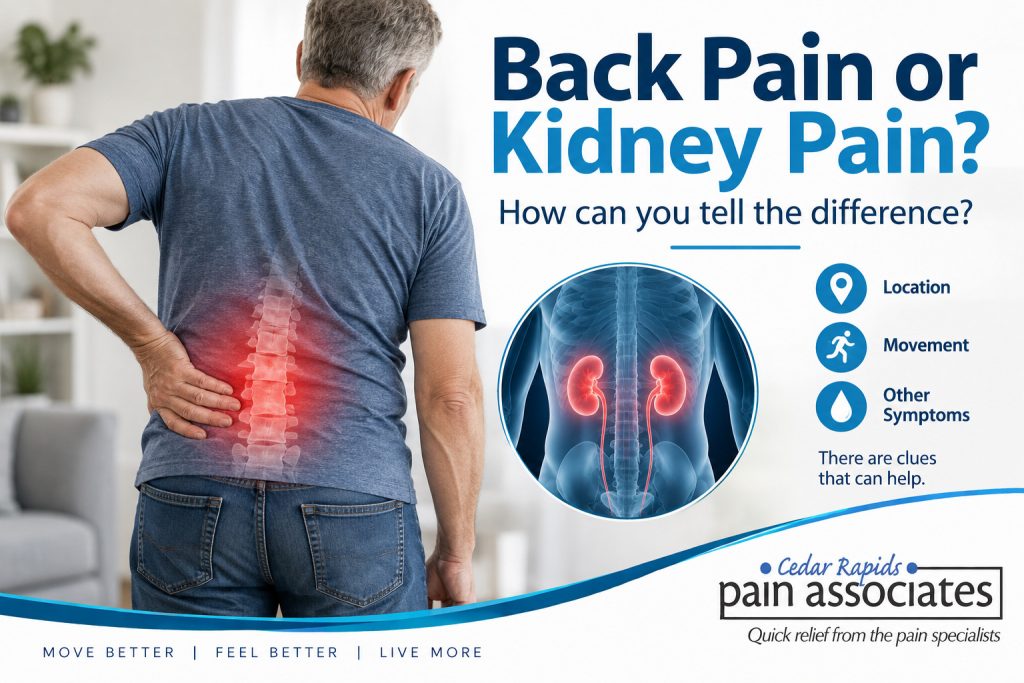
Your back hurts. But is the problem actually coming from your spine and muscles — or could it be your kidneys?
Because the kidneys are located toward the back of the abdomen, kidney-related discomfort can sometimes be mistaken for ordinary back pain.
While there can be overlap, there are several clues that may help tell the difference.
🦴 What Does Typical Back Pain Feel Like?
Most back pain is musculoskeletal, meaning it originates from structures such as the muscles, joints, discs, ligaments, or nerves.
Back pain may feel like:
🔹 Aching or stiffness
🔹 Sharp or stabbing pain
🔹 Muscle tightness or spasms
🔹 Pain with bending, twisting, standing, or lifting
🔹 Pain that travels into the buttock or leg
🔹 Numbness or tingling associated with nerve irritation
One important clue is that musculoskeletal back pain frequently changes with movement or position.
You might feel worse when you:
🧍 Stand for a long time
🪑 Sit for a long time
↪️ Bend or twist
🏋️ Lift something
🚶 Walk a certain distance
🛏️ Move into certain positions
Changing positions, resting, stretching, or moving may also change the intensity of the pain.
🩺 What Does Kidney Pain Feel Like?
Kidney pain is generally felt higher and deeper than typical low back pain.
The kidneys sit toward the back of your abdomen, underneath the lower ribs on either side of your spine.
Kidney-related pain may:
🔸 Be felt underneath or just below the ribs
🔸 Occur more on one side
🔸 Feel deep rather than muscular
🔸 Extend toward the abdomen or groin
🔸 Remain relatively constant despite changing positions
Unlike many musculoskeletal problems, kidney pain often doesn’t significantly improve or worsen simply because you bend, twist, sit, or change positions.
🔎 Location Can Provide an Important Clue
🦴 Back or Spine-Related Pain
Pain is commonly felt:
📍 In the center of the lower back
📍 On either side of the lower spine
📍 Across the beltline
📍 Into the buttock
📍 Down one or both legs
🩺 Kidney-Related Pain
Pain is more commonly felt:
📍 Higher in the back
📍 Underneath the lower ribs
📍 To one side of the spine
📍 Deep inside the flank
📍 Sometimes radiating toward the abdomen or groin
Location alone, however, isn’t enough to make a diagnosis.
🌡️ Look for Other Symptoms
This is where the difference may become more noticeable.
Back pain caused by a muscle, joint, disc, or spinal condition usually doesn’t cause urinary symptoms or fever.
Kidney problems may be accompanied by symptoms such as:
🚽 Pain or burning with urination
🚽 Frequent or urgent urination
🩸 Blood in the urine
🌡️ Fever or chills
🤢 Nausea or vomiting
😣 Significant pain in the side or flank
☁️ Cloudy or unusual-smelling urine
If you’re experiencing these symptoms along with back or flank pain, you should contact an appropriate healthcare provider.
💧 What About Kidney Stones?
Kidney stones can cause particularly intense pain.
The pain may:
⚡ Begin suddenly
⚡ Become severe
⚡ Come in waves
⚡ Start in the side or back
⚡ Travel toward the lower abdomen or groin
⚡ Be accompanied by nausea, vomiting, or blood in the urine
People with kidney stones may have difficulty finding a comfortable position because of the intensity of the pain.
Severe or unexplained flank pain should be medically evaluated.
🦴 What Could Be Causing Back Pain?
If the kidneys aren’t the problem, there are many possible sources of back pain.
Some common causes include:
🔹 Muscle strains
🔹 Herniated or bulging discs
🔹 Degenerative disc disease
🔹 Facet joint arthritis
🔹 Sacroiliac (SI) joint dysfunction
🔹 Spinal stenosis
🔹 Sciatica and other forms of nerve irritation
Determining the actual source of the pain is important because different conditions require different treatments.
🔎 How Do We Determine What’s Causing Your Back Pain?
At Cedar Rapids Pain Associates, evaluation begins by listening to your symptoms and performing a physical examination.
We may look at:
❓ Where exactly does it hurt?
❓ What movements make it worse?
❓ Does the pain travel anywhere?
❓ Does sitting or standing change the pain?
❓ Are you experiencing numbness or tingling?
❓ How long has the problem been present?
When appropriate, imaging or other diagnostic testing may be recommended.
The goal isn’t simply to identify where you hurt — it’s to determine why you hurt.
🩺 Treatment Options for Musculoskeletal Back Pain
Once the source of the pain has been identified, treatment can be tailored to the individual patient.
At Cedar Rapids Pain Associates, treatment options may include:
💉 Spinal Procedures
Depending on the diagnosis, options may include epidural steroid injections, medial branch blocks, radiofrequency ablation, and SI joint injections.
💉 Trigger Point & Joint Injections
Injections may be considered when muscles, trigger points, or joints are contributing to pain.
🔵 Non-Surgical Spinal Decompression
Spinal decompression may be considered for certain disc-related conditions as part of a conservative treatment plan.
🦴 BMAC (Bone Marrow Aspirate Concentrate)
BMAC is a regenerative treatment prepared from a patient’s own bone marrow. It may be considered for certain degenerative joint and musculoskeletal conditions when appropriate.
🩸 PRP Injections
Platelet-Rich Plasma uses a concentrated portion of the patient’s own blood and may be considered for certain joint, tendon, ligament, and musculoskeletal conditions.
🌊 Extracorporeal Shockwave Therapy
Shockwave therapy uses acoustic energy and may be considered for certain chronic musculoskeletal and soft-tissue conditions.
🔴 MLS Robotic Laser Therapy
MLS Laser Therapy provides non-invasive photobiomodulation and may be incorporated into treatment plans for certain musculoskeletal conditions.
🏃 Physical Therapy
Individualized exercises and rehabilitation can help improve strength, flexibility, mobility, and function.
👐 Chiropractic Care
For appropriate patients, chiropractic treatment may help improve mobility and address certain mechanical causes of back pain.
🚨 When Back Pain Needs Immediate Medical Attention
Some symptoms shouldn’t wait for a routine appointment.
Seek prompt or emergency medical evaluation if back or flank pain occurs with:
🔴 Fever or chills, particularly with urinary symptoms or feeling very ill
🔴 Persistent vomiting or inability to keep fluids down
🔴 Visible blood in the urine with significant pain
🔴 New loss of bowel or bladder control
🔴 Numbness around the groin or inner thighs
🔴 New or rapidly worsening leg weakness
🔴 Severe, sudden, or rapidly worsening pain
These symptoms can indicate conditions that require more urgent evaluation.
🔵 Not Sure Where Your Back Pain Is Coming From?
Back pain has many possible causes, and figuring out what structure is actually responsible for your symptoms is an important first step toward choosing the right treatment.
If your symptoms appear to be coming from your muscles, joints, discs, or spine, the team at Cedar Rapids Pain Associates can evaluate your condition and discuss treatment options appropriate for you.
📞 319-294-0094
⚡ Appointments in days, not weeks.
✅ No referral needed.
🏥 All major insurances accepted.
💙 All care performed in our office — no additional facility fees.