
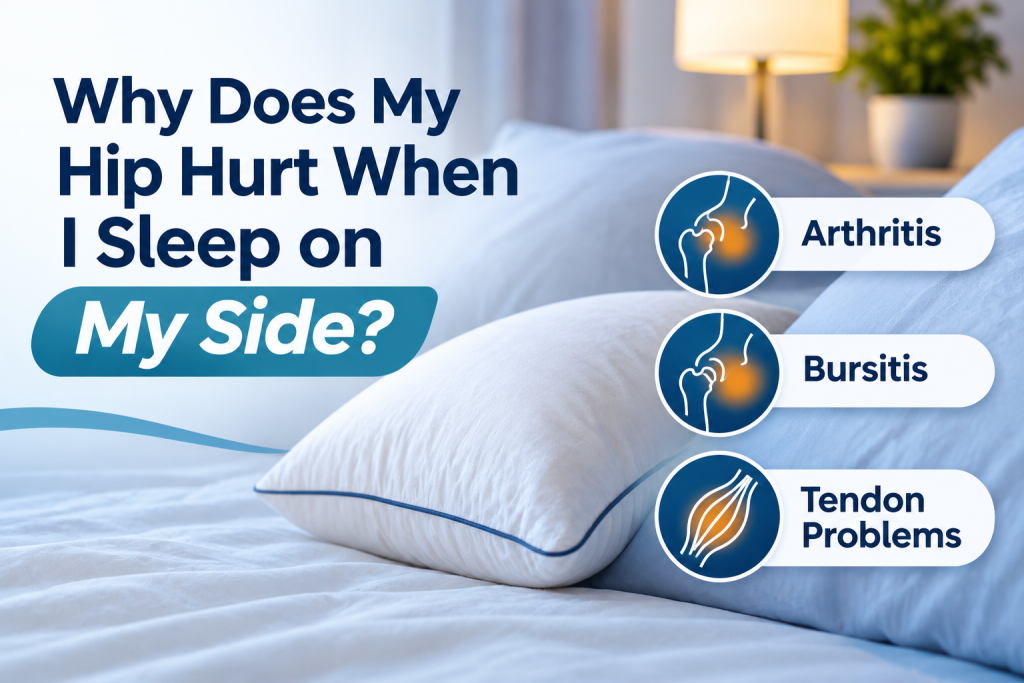
Understanding the Causes of Nighttime Hip Pain and What You Can Do About It
Have you ever settled into bed after a long day, only to discover that lying on your side makes your hip ache? Maybe you find yourself constantly switching positions throughout the night, trying to get comfortable. Or perhaps you wake up in the morning with hip stiffness and soreness.
If this sounds familiar, you’re not alone. Hip pain while sleeping on your side is a common complaint, particularly among adults over 40.
The good news? There are several possible explanations for nighttime hip pain, and many can be treated without surgery.
At Cedar Rapids Pain Associates, we help patients identify the source of their hip pain and explore treatment options to improve comfort, mobility, and quality of life.
🔵 Why Does Sleeping on Your Side Cause Hip Pain?
When you sleep on your side, your body weight places pressure on the outside of your hip. If the muscles, tendons, or other tissues surrounding the hip are irritated, this additional pressure can make the discomfort worse.
Interestingly, the hip that hurts isn’t always the one you’re lying on. Sometimes the upper hip becomes painful because of the position of your leg and the tension placed on the surrounding tendons.
Several conditions can contribute to this discomfort.
🔵 1. Hip Bursitis: A Common Cause of Side-Sleeping Pain
One possible cause of pain on the outside of the hip is trochanteric bursitis.
A bursa is a small, fluid-filled sac that helps reduce friction between bones, muscles, and tendons. When the bursa near the outside of your hip becomes irritated, it can cause tenderness and pain.
Common symptoms include:
- ✓ Pain on the outside of the hip
- ✓ Tenderness when pressing on the affected area
- ✓ Increased pain when lying on the affected side
- ✓ Discomfort when climbing stairs or walking for extended periods
- ✓ Pain that sometimes travels down the outside of the thigh
Although bursitis is often blamed for lateral hip pain, many cases actually involve irritation or injury of the nearby gluteal tendons.
🔵 2. Gluteal Tendinopathy: An Often-Overlooked Cause
The gluteal muscles do more than help you walk and climb stairs. They also stabilize your pelvis and support your hips.
The tendons connecting these muscles to the hip can become irritated or weakened over time, a condition known as gluteal tendinopathy.
This condition is particularly common in middle-aged and older adults.
Symptoms may include:
- ✓ Aching or burning pain on the outside of the hip
- ✓ Pain when lying on either side
- ✓ Discomfort when standing on one leg
- ✓ Pain when climbing stairs or getting out of a chair
- ✓ Increased soreness after walking or exercising
Gluteal tendinopathy and trochanteric bursitis are often grouped under the term Greater Trochanteric Pain Syndrome (GTPS).
Treatment frequently involves modifying activities that aggravate the tendons and gradually strengthening the surrounding muscles.
🔵 3. Hip Arthritis: When the Joint Itself Is the Problem
Hip osteoarthritis develops when the cartilage that cushions the joint gradually deteriorates.
Although arthritis often causes pain in the groin or front of the hip, some people experience discomfort in the buttock, thigh, or outer hip.
Signs that arthritis may be contributing to your pain include:
- ✓ Stiffness after sitting or resting
- ✓ Difficulty putting on shoes or socks
- ✓ Reduced hip flexibility
- ✓ Pain when walking or standing for long periods
- ✓ Aching discomfort that interferes with sleep
Arthritis-related hip pain may become more noticeable at night after a physically demanding day.
Fortunately, many people can manage symptoms with conservative care and appropriate medical treatment.
🔵 4. Your Lower Back Could Be Contributing
Sometimes what feels like hip pain actually originates in the lower back.
Conditions such as lumbar arthritis, spinal stenosis, or nerve irritation can produce pain that travels into the buttock or hip region.
Clues that your lower back may be involved include:
- ✓ Pain extending below the knee
- ✓ Tingling, numbness, or burning sensations
- ✓ Back pain accompanying hip discomfort
- ✓ Symptoms that change significantly with spinal position
Identifying the true source of pain is important because treatments for spinal conditions differ from those used for hip problems.
🔵 5. Your Sleeping Position May Be Making Things Worse
Even without a significant underlying injury, certain sleeping positions can increase pressure on sensitive tissues.
For example, lying on your side with your top knee dropping across your body can increase compression of the tendons along the outside of your hip.
A mattress that doesn’t provide adequate support may also contribute to discomfort.
💤 Simple Changes That May Help You Sleep Better
✓ Place a pillow between your knees.
This can help keep your hips aligned and reduce stress on the outer hip.
✓ Avoid sleeping directly on the painful hip.
Try sleeping on your back with a pillow beneath your knees or on your more comfortable side with a pillow supporting the upper leg.
✓ Consider your mattress.
A mattress that is excessively firm may increase pressure on the hip, while one that is too soft may provide inadequate support.
✓ Avoid aggressive stretching if it makes the pain worse.
Certain stretches can increase compression on irritated gluteal tendons. Gentle movement and appropriate strengthening exercises may be more beneficial.
✓ Stay active within your comfort level.
Prolonged inactivity can contribute to stiffness and weakness. Low-impact activity, such as walking, may help maintain mobility without placing excessive stress on the joint.
🔵 When Should You Seek Treatment for Hip Pain?
Occasional hip discomfort may improve with simple changes. However, persistent pain shouldn’t be ignored.
Consider scheduling an evaluation if:
- ✓ Hip pain regularly wakes you up at night
- ✓ You cannot comfortably sleep on either side
- ✓ Symptoms have persisted for more than a week or two without improvement
- ✓ Pain is affecting your ability to walk, exercise, or perform everyday activities
- ✓ You notice increasing stiffness or reduced mobility
Seek prompt medical attention for severe pain after a fall, inability to bear weight, fever with a painful hip, or sudden significant weakness.
🔵 Advanced, Nonsurgical Treatment Options at Cedar Rapids Pain Associates
At Cedar Rapids Pain Associates, we understand how frustrating persistent hip pain can be, especially when it interferes with your sleep and daily activities.
That’s why we offer a comprehensive range of medical, regenerative, interventional, and advanced nonsurgical treatment options designed to help patients reduce pain, improve mobility, and return to the activities they enjoy.
Our goal is to identify the underlying cause of your hip pain and develop a personalized treatment plan that works for you.
🩺 Medical Evaluation and Pain Management
Our experienced medical providers perform comprehensive evaluations to help identify the source of your hip pain.
Depending on your symptoms, we may recommend diagnostic imaging, medications, targeted treatments, or other appropriate options.
🧬 Regenerative Medicine — PRP and BMAC
We offer regenerative medicine treatments, including Platelet-Rich Plasma (PRP) and Bone Marrow Aspirate Concentrate (BMAC).
These treatments use concentrated components obtained from your own body and may be considered for selected joint and tendon conditions.
Our providers can help determine whether these options are appropriate based on your diagnosis, medical history, and treatment goals.
💉 Interventional Pain Procedures
For patients experiencing persistent hip pain, targeted injections and other interventional procedures may provide meaningful relief.
Depending on the underlying condition, options may include:
- ✓ Hip joint injections
- ✓ Greater trochanteric bursa injections
- ✓ Other targeted pain-relieving procedures
These treatments may help reduce inflammation and discomfort, allowing patients to move more comfortably and participate in rehabilitation.
✨ Advanced Pain Relief — MLS Robotic Laser Therapy and Shockwave Therapy
At Cedar Rapids Pain Associates, we’re proud to offer advanced, noninvasive technologies that provide additional options for patients seeking relief from musculoskeletal pain.
🔹 MLS Robotic Laser Therapy
MLS Robotic Laser Therapy uses specialized light energy to treat targeted areas of the body.
This comfortable, noninvasive treatment is designed to help:
- ✓ Reduce pain and inflammation
- ✓ Support the body’s natural recovery processes
- ✓ Improve comfort and mobility
- ✓ Provide a treatment option without injections or surgery
MLS Laser Therapy can be incorporated into a personalized treatment plan for selected hip-related muscle and tendon conditions.
🔹 Shockwave Therapy
Shockwave Therapy uses targeted acoustic waves to stimulate biological responses in injured or irritated tissues.
It is a nonsurgical treatment option for certain chronic tendon conditions, including selected cases of gluteal tendinopathy and greater trochanteric pain syndrome.
Potential benefits include:
- ✓ Reduced pain and tenderness
- ✓ Improved function and mobility
- ✓ Stimulation of local tissue-repair responses
- ✓ No injections or surgical incisions
- ✓ Minimal downtime for many patients
Together, MLS Laser Therapy and Shockwave Therapy give our patients additional advanced treatment options that can be incorporated into an individualized, nonsurgical approach to pain relief.
🏃 Physical Therapy
Our in-house physical therapy team helps patients improve strength, flexibility, balance, and movement.
For many individuals with gluteal tendon problems, a progressive strengthening program is an important part of long-term recovery.
Physical therapy can help address muscle weakness, improve hip stability, and reduce stress on irritated tissues.
🙌 Chiropractic Care
Chiropractic care may be beneficial when related spinal, pelvic, or other musculoskeletal issues contribute to discomfort.
Our chiropractors evaluate joint mobility and movement patterns and provide appropriate conservative care as part of our multidisciplinary treatment approach.
💙 Don’t Let Hip Pain Steal Another Night of Sleep!
If you’re constantly switching sides in bed, waking up with an aching hip, or avoiding activities because of discomfort, it may be time to find out what’s causing the problem.
You don’t have to simply accept hip pain as a normal part of getting older!
At Cedar Rapids Pain Associates, our multidisciplinary team offers a wide range of treatment options, all conveniently available in one location.
Whether your hip pain is related to arthritis, bursitis, tendon problems, or another condition, we’re here to help you explore ways to reduce pain and improve your quality of life.
📞 Ready to Get Your Hip Pain Checked Out?
CEDAR RAPIDS PAIN ASSOCIATES
“Quick Relief from the Pain Specialists”
📍 4205 Glass Rd NE, Cedar Rapids, IA 52402
📞 319-294-0094
🌐 www.crpainfree.com
Why Choose Us?
✅ No referral needed
✅ All major insurances accepted
✅ Appointments in days, not weeks
✅ All care performed in office — no facility fees
✅ Multiple advanced treatment options under one roof
Don’t let another sleepless night go by. Call Cedar Rapids Pain Associates today and take the first step toward better sleep and less pain!