
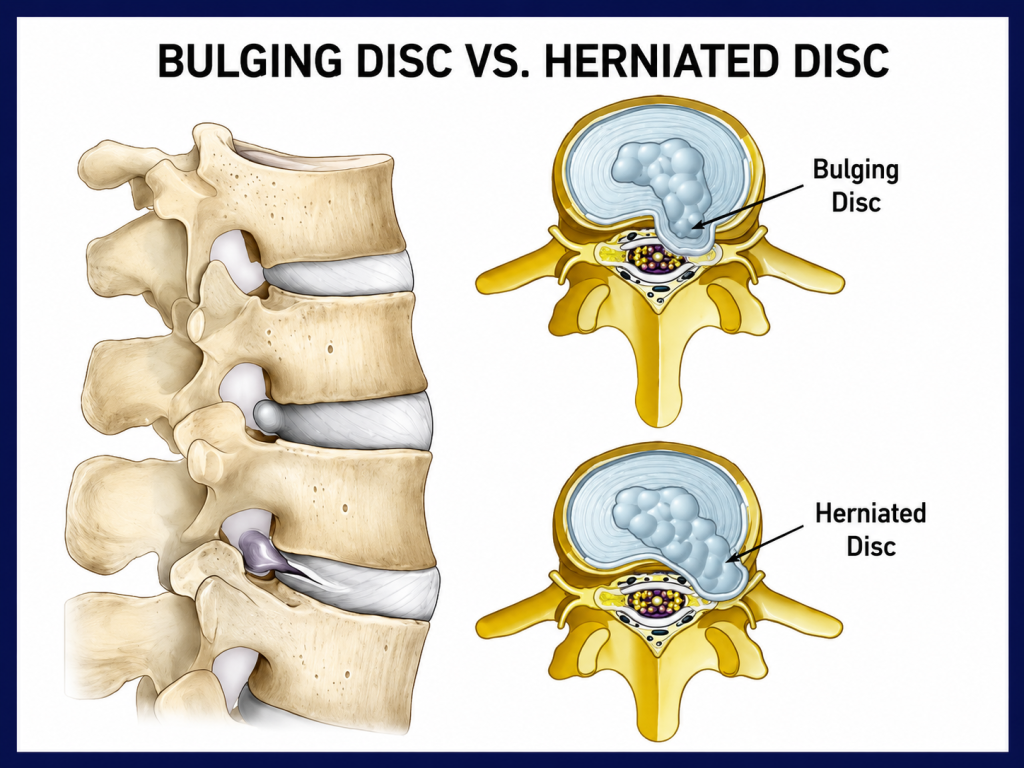
If you’ve recently had an MRI of your neck or back, you may have been told that you have a bulging disc or a herniated disc. While these terms are often used interchangeably, they are not exactly the same thing.
Understanding the difference can help you better understand your diagnosis and treatment options.
✅ The good news is that both conditions are common, and many people improve with conservative, non-surgical treatment.
🦴 Understanding the Anatomy of a Disc
Between each vertebra in your spine is a spinal disc that acts as a cushion and shock absorber.
Each disc has two main parts:
🔹 Annulus Fibrosus – The tough outer layer
🔹 Nucleus Pulposus – The soft, gel-like center
These discs help absorb forces placed on the spine while allowing flexibility and movement.
Over time, age-related wear and tear, repetitive stress, injuries, and genetics can cause discs to weaken.
🔵 What Is a Bulging Disc?
A bulging disc occurs when the outer layer of the disc weakens and the disc begins to extend beyond its normal boundaries.
Think of a bulging disc like a hamburger that’s slightly too large for the bun—the entire disc protrudes outward but remains intact.
Characteristics of a Bulging Disc:
✅ Outer layer remains intact
✅ Disc extends outward in a broad, uniform manner
✅ May or may not cause symptoms
Many people have bulging discs and never experience pain.
In fact, MRI studies show that disc bulges become increasingly common with age—even among people who have no symptoms.
🔴 What Is a Herniated Disc?
A herniated disc occurs when there is a tear or weakness in the outer layer of the disc, allowing some of the inner gel-like material to push outward.
You may also hear it called:
🔸 Herniated Disc
🔸 Ruptured Disc
🔸 Slipped Disc
🔸 Disc Extrusion
Unlike a bulging disc, a herniated disc involves actual displacement of the disc’s inner material.
⚠️ Because the herniated material can irritate nearby nerves, it is more likely to cause symptoms.
📋 Symptoms of a Bulging Disc
Many bulging discs cause no symptoms at all.
When symptoms do occur, they may include:
✔️ Localized neck pain
✔️ Localized back pain
✔️ Stiffness
✔️ Muscle tightness
✔️ Reduced range of motion
Symptoms typically occur when the bulge begins to irritate surrounding structures.
⚡ Symptoms of a Herniated Disc
Herniated discs are more likely to produce nerve-related symptoms.
🧠 In the Neck
✔️ Neck pain
✔️ Shoulder pain
✔️ Arm pain
✔️ Numbness or tingling in the hands
✔️ Weakness in the arm
🦵 In the Lower Back
✔️ Low back pain
✔️ Sciatica
✔️ Pain radiating into the buttock or leg
✔️ Numbness or tingling in the foot
✔️ Leg weakness
The symptoms often depend on which nerve is being compressed.
⚖️ Which Is More Serious?
Generally speaking, a herniated disc is considered more significant because it is more likely to compress or irritate nearby nerves.
However, the severity of symptoms does not always match MRI findings.
🔍 Some patients have large herniated discs with minimal symptoms.
🔍 Others have relatively small disc abnormalities that cause significant pain.
The most important factor is not what the MRI looks like—it’s how the disc is affecting nearby nerves and your daily function.
🔄 Can Bulging Discs Become Herniated?
✅ Yes.
Over time, continued stress on a weakened disc can lead to further degeneration and eventual herniation.
This is one reason why maintaining spinal health through:
✔️ Exercise
✔️ Good posture
✔️ Weight management
✔️ Proper lifting mechanics
can be so important.
🩺 How Are Disc Problems Diagnosed?
Your provider may recommend:
📌 Medical History
📌 Physical Examination
📌 Orthopedic Testing
📌 Neurological Examination
📌 X-Rays
📌 MRI Imaging
MRI is typically the best imaging study for evaluating spinal discs and nerve compression.
💙 Non-Surgical Treatment Options
The encouraging news is that most patients with bulging or herniated discs do not require surgery.
At Cedar Rapids Pain Associates, treatment options may include:
🩻 Spinal Procedures
✔️ Epidural Steroid Injections
✔️ Medial Branch Blocks
✔️ Radiofrequency Ablation (RFA)
✔️ Selective Nerve Root Blocks
💉 Trigger Point & Joint Injections
May help reduce inflammation and muscular compensation surrounding the affected area.
🔧 Non-Surgical Spinal Decompression
Gently stretches the spine and may help reduce pressure on affected discs and nerves.
🌱 PRP & BMAC (“Stem Cell”) Injections
May help support the body’s natural healing response in select patients.
⚡ Shockwave Therapy
May stimulate healing and improve function in chronic musculoskeletal conditions.
🔴 MLS Robotic Laser Therapy
May help reduce inflammation, improve circulation, and decrease pain.
🏃 Physical Therapy
Helps improve strength, flexibility, posture, and spinal stability.
🤝 Chiropractic Care
May help improve mobility and function when clinically appropriate.
🚨 When Should You See a Specialist?
Consider seeking evaluation if you experience:
⚠️ Persistent neck or back pain
⚠️ Sciatica
⚠️ Pain radiating into the arms or legs
⚠️ Numbness or tingling
⚠️ Weakness
⚠️ Symptoms affecting work, exercise, or daily activities
Early treatment may help prevent symptoms from worsening and improve recovery.
✅ The Bottom Line
A bulging disc and a herniated disc are similar but not identical conditions.
🔵 Bulging Disc: The disc extends beyond its normal boundaries but remains intact.
🔴 Herniated Disc: The inner material pushes through a weakened or torn outer layer.
Both can cause pain, but herniated discs are more likely to produce nerve-related symptoms such as sciatica, numbness, tingling, and weakness.
Fortunately, many patients experience significant improvement with non-surgical treatment.
📅 Schedule an Appointment
Cedar Rapids Pain Associates
📍 4205 Glass Rd NE, Cedar Rapids, IA 52402
📞 (319) 294-0094
✅ No Referral Needed
✅ Same-Week Appointments Often Available
“Quick Relief from the Pain Specialists”