
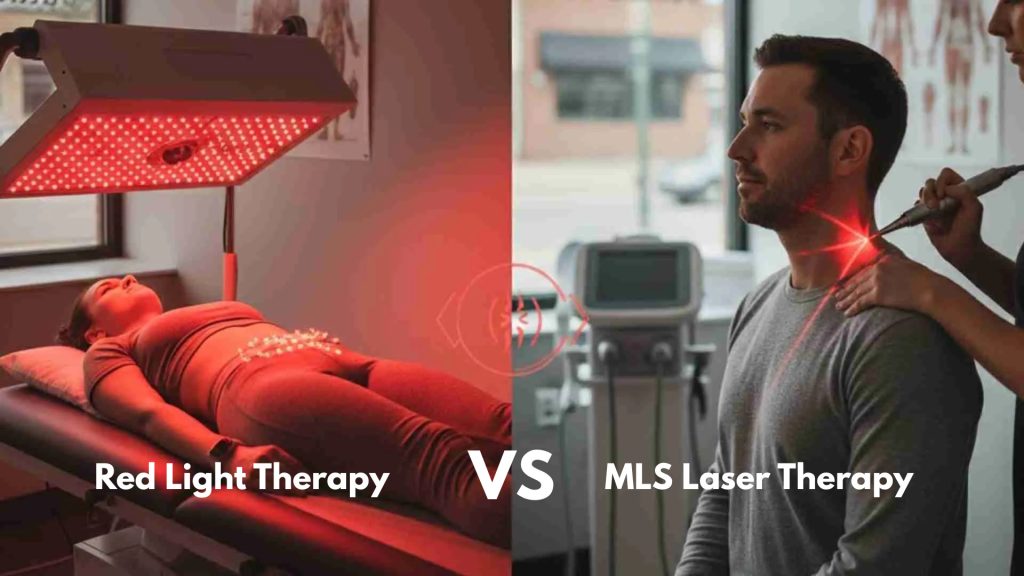
Light-based therapies have become increasingly popular for pain relief, healing, recovery, and wellness. But many people wonder:
“What’s the difference between red light therapy and MLS laser therapy?”
While both use light energy to support healing, they are very different in strength, depth, technology, and medical purpose.
Here’s what you should know.
🔴 What Is Red Light Therapy?
Red light therapy (sometimes called low-level light therapy or LED therapy) uses low-intensity red and near-infrared light to stimulate cells near the surface of the skin.
It is commonly used for:
- Skin health
- Recovery and wellness
- Muscle soreness
- Mild inflammation
- Circulation support
Red light therapy is often found in:
- Home devices
- Wellness spas
- Gyms
- Beauty clinics
🌈 Red Light Therapy Wavelengths
Most red light therapy devices use wavelengths in the:
- Red light range: ~620–700 nanometers (nm)
- Near-infrared range: ~700–1100 nm
Common wavelengths include:
- 630 nm
- 660 nm
- 810 nm
- 850 nm
Why Wavelengths Matter
Different wavelengths penetrate the body at different depths.
- Red light (around 630–660 nm) tends to work more superficially and is commonly used for skin and surface tissues.
- Near-infrared light (around 810–850 nm) penetrates deeper into muscles and tissues.
However, most traditional red light therapy systems still operate at lower power levels compared to medical laser systems.
⚡ What Is MLS Laser Therapy?
MLS stands for Multiwave Locked System laser therapy.
MLS laser therapy is a more advanced, medical-grade treatment designed specifically to help reduce pain and inflammation while supporting tissue healing.
Unlike standard red light therapy, MLS uses synchronized laser wavelengths that penetrate deeper into tissues.
MLS laser therapy is commonly used for:
- Back pain
- Neck pain
- Sciatica
- Joint pain
- Arthritis
- Tendon and ligament injuries
- Neuropathy
- Muscle spasms
- Sports injuries
🔬 MLS Laser Therapy Wavelengths
MLS laser therapy uses two synchronized wavelengths that work together:
🔴 808 nm Continuous Wave
Primarily focused on:
- Reducing inflammation
- Improving circulation
- Supporting tissue repair
⚡ 905 nm Pulsed Wave
Focused more on:
- Pain relief
- Reducing nerve sensitivity
- Deep tissue penetration
The MLS system “locks” these wavelengths together so they work simultaneously and in sync.
This synchronized delivery is one of the key differences between MLS laser therapy and standard red light devices.
🔍 The Biggest Differences
1. Power & Intensity
Red Light Therapy
- Lower-powered
- Usually LED-based
- More wellness-focused
MLS Laser Therapy
- Higher-powered medical laser
- Designed for therapeutic treatment
- Often used in clinical settings
2. Depth of Penetration
Red Light Therapy
Works more superficially near the skin surface.
MLS Laser Therapy
Penetrates deeper into muscles, joints, ligaments, and nerves.
This deeper penetration is one reason MLS laser therapy is commonly used for pain conditions.
3. Treatment Goals
Red Light Therapy
Typically focused on:
- General wellness
- Skin appearance
- Mild recovery support
MLS Laser Therapy
Focused more on:
- Pain relief
- Reducing inflammation
- Improving mobility
- Accelerating healing
4. Technology
Red Light Therapy
Usually uses LEDs with broader light dispersion.
MLS Laser Therapy
Uses synchronized dual wavelengths that are specifically engineered to:
- Reduce inflammation
- Improve circulation
- Support tissue repair
- Reduce pain signals
🩺 Which One Is Better for Pain?
Both therapies may provide benefits, but MLS laser therapy is generally considered more powerful and targeted for treating musculoskeletal pain conditions.
People with:
- Chronic pain
- Arthritis
- Sciatica
- Tendon injuries
- Neuropathy
- Back or neck pain
often need deeper tissue penetration and stronger therapeutic effects than standard red light therapy typically provides.
⏱ What Does MLS Laser Therapy Feel Like?
Most patients describe MLS laser therapy as:
- Comfortable
- Relaxing
- Fast
- Non-invasive
Treatments usually take only about 10–15 minutes depending on the area treated.
There is no downtime afterward.
🌿 A Non-Surgical Option for Pain Relief
Many people are looking for non-surgical, drug-free ways to help reduce pain and improve function.
MLS laser therapy may help:
- Improve mobility
- Reduce inflammation
- Decrease muscle tightness
- Support healing
- Help patients stay active
📍MLS Laser Therapy at Cedar Rapids Pain Associates
At Cedar Rapids Pain Associates, we offer advanced MLS Robotic Laser Therapy as part of our comprehensive approach to pain relief and recovery.
We combine multiple specialties under one roof to help patients get the care they need quickly.
✅ Appointments within days—not weeks
✅ Most major insurances accepted
✅ No referral needed
✅ Multidisciplinary care in one location
📞 (319) 294-0094
🌐 crpainfree.com