
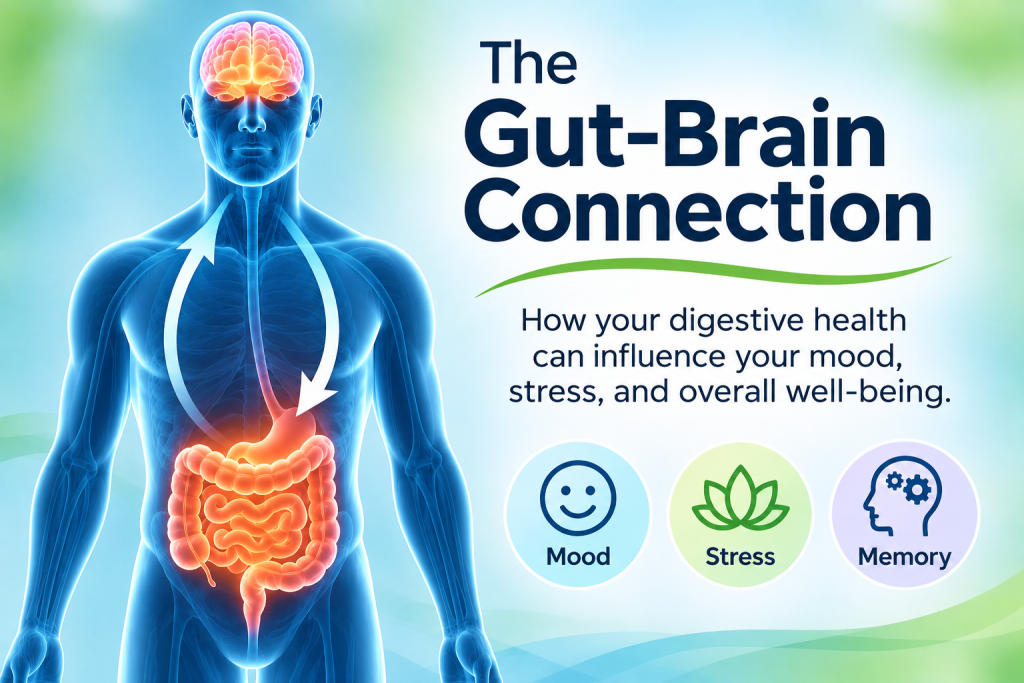
Did you know that your gut and your brain are constantly communicating?
Scientists are discovering that the trillions of microorganisms living in your digestive system may influence much more than digestion. They may also play a role in your mood, stress levels, memory, and overall mental well-being.
This fascinating relationship is known as the gut-brain connection, and it’s one of the most exciting areas of health research today.
🔵 Your Gut Has Its Own Nervous System!
Your digestive system contains an extensive network of more than 100 million nerve cells called the enteric nervous system. It’s so complex that scientists sometimes refer to it as your body’s “second brain.”
While your gut doesn’t actually think or make decisions like your brain, it helps control digestion and communicates with your central nervous system.
One important communication pathway is the vagus nerve, which carries signals between your brain and many internal organs, including your digestive tract.
💡 Interesting Fact: Communication between your gut and brain works both ways. Your brain can influence digestion, and signals originating in your gut can influence brain activity.
🦠 Trillions of Tiny Organisms May Influence Your Mood
Your digestive tract is home to trillions of bacteria, viruses, fungi, and other microorganisms. Together, they make up your gut microbiome.
These microorganisms help digest certain foods, produce beneficial compounds, support immune function, and maintain a healthy intestinal environment.
Researchers are investigating several ways gut bacteria may communicate with the brain:
- 🔹 Neurotransmitters: Gut microorganisms can produce or influence chemicals involved in nervous system signaling.
- 🔹 Inflammation: The gut microbiome helps regulate immune responses that may affect brain health.
- 🔹 The Vagus Nerve: Signals traveling between the gut and brain may influence stress responses and emotional processing.
- 🔹 Short-Chain Fatty Acids: Beneficial compounds produced when gut bacteria ferment dietary fiber may influence several aspects of health.
Although research is promising, scientists are still determining exactly how these mechanisms affect human mood and behavior.
🟢 Amazing Fact: Most of Your Body’s Serotonin Is Produced in Your Gut!
Serotonin is commonly associated with happiness and emotional well-being.
Surprisingly, approximately 90–95% of the body’s serotonin is produced in the gastrointestinal tract!
However, there’s an important distinction: serotonin produced in the gut does not simply travel into the brain to improve your mood.
Instead, gut serotonin primarily helps regulate digestive and other bodily functions, while serotonin produced within the brain participates in mood regulation.
It’s another fascinating example of how interconnected our body’s systems are!
🔵 Can Your Gut Health Affect Anxiety and Stress?
Scientists have found associations between changes in the gut microbiome and conditions such as anxiety and depression.
Research suggests that gut microorganisms may influence the body’s stress-response systems and certain pathways involved in emotional regulation.
Interestingly, the relationship also works in reverse.
Have you ever experienced an upset stomach before a big presentation, job interview, or stressful event?
That’s your gut-brain connection in action!
Stress can change digestive movement, sensitivity, and other gastrointestinal functions. Researchers are studying whether these changes can also affect the gut microbiome.
While scientists are investigating probiotics and other microbiome-based approaches for mental health, the evidence is not yet strong enough to consider them replacements for established treatments.
🌿 6 Simple Ways to Support a Healthy Gut
The good news is that many everyday habits that support overall health can also benefit your digestive system.
🥦 1. Eat More Fiber-Rich Foods
Vegetables, fruits, beans, lentils, and whole grains provide fiber that beneficial gut bacteria can use.
🥛 2. Include Fermented Foods
Foods such as yogurt with live cultures, kefir, kimchi, and sauerkraut may introduce helpful microorganisms into your diet.
🚶 3. Get Regular Exercise
Physical activity supports digestive health and may contribute to a healthier, more diverse gut microbiome.
😴 4. Prioritize Quality Sleep
Consistent sleep habits support your body’s natural rhythms and overall health.
🧘 5. Manage Daily Stress
Walking, deep breathing, meditation, and spending time outdoors may help reduce stress and support digestive comfort.
🥗 6. Eat a Variety of Plant Foods
Different plants provide different fibers and nutrients. A varied diet can help support a diverse community of gut microorganisms.
🔬 What About Probiotics?
You’ve probably seen advertisements for probiotic supplements promising better digestion, improved mood, and even sharper thinking.
Probiotics are live microorganisms that may provide health benefits when consumed in appropriate amounts.
However, not all probiotics are the same.
Different bacterial strains have different effects, and benefits demonstrated for one condition cannot automatically be applied to another.
Some probiotics have evidence supporting specific digestive uses, but claims about improving memory, anxiety, or depression remain under investigation.
✅ Healthy Habit: For most generally healthy adults, focusing on a balanced, fiber-rich diet is a practical starting point for supporting gut health.
🧬 The Future of Gut-Brain Research Is Exciting!
Scientists are exploring whether understanding the gut microbiome could eventually lead to more personalized approaches to managing certain neurological and mental health conditions.
Researchers are studying potential connections between gut microorganisms and:
- 🧠 Alzheimer’s disease — Investigating relationships between gut bacteria, inflammation, and cognitive decline.
- 🔬 Parkinson’s disease — Exploring how changes in the gut microbiome may relate to neurological symptoms.
- 💭 Depression and anxiety — Studying how microorganisms may influence stress and emotional regulation.
- 📚 Memory and cognitive function — Examining potential relationships between gut health and brain performance.
- 😴 Sleep and stress — Investigating how the microbiome interacts with the body’s natural rhythms.
These findings are exciting, but many studies are preliminary. Discovering a connection does not necessarily mean that changes in gut bacteria cause a disease or that altering the microbiome can treat it.
More human clinical trials are needed to understand which interventions are genuinely effective.
💙 The Bottom Line: A Healthy Gut Is Part of a Healthy Body
Your digestive system does much more than process food. It communicates with your brain, interacts with your immune system, and supports many essential bodily functions.
Although researchers are still uncovering the full extent of the gut-brain connection, one thing is clear: taking care of your digestive health is an important part of taking care of your overall health.
Simple habits such as eating more fiber, staying physically active, managing stress, and getting adequate sleep can make a meaningful difference.
Your gut and brain are a team — give them both the care they deserve!
💙 Cedar Rapids Pain Associates
“Quick Relief from the Pain Specialists”
📍 4205 Glass Rd NE, Cedar Rapids, IA 52402
📞 (319) 294-0094